
We’re going to war?
Actual words from the pulpit at Beulah Camp in Brown’s Flat, New Brunswick on Tuesday morning this week:
“Friday night. Honestly, I have a sermon for you on Friday night. And I don’t know about the kids because it’s—I’m going to talk about Sodom and Gomorrah… We’re going to war Friday night… If you’re concerned about your kids hearing some stuff, then sit on the edge. Okay. Okay. And if you’re okay with it, just know that’s what’s happening.”
Rev. Dr. Darren Campbell
I will agree with the preacher on one thing:
The kids should stay home.
Because I know Beulah Camp.
I grew up there.
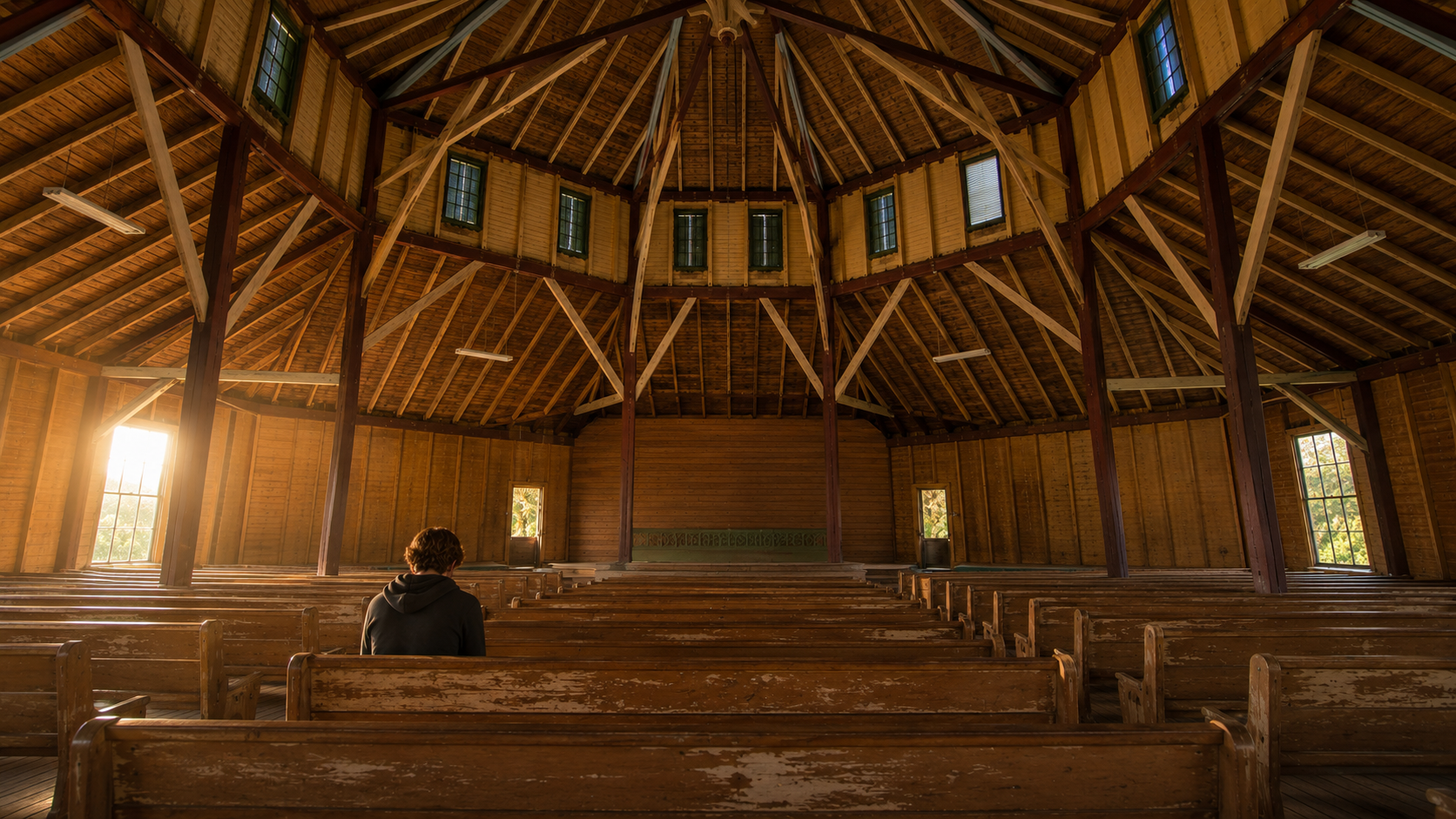
I Know Those Pews
I spent my childhood and teenage summers walking those dusty roads, sitting in those pews, singing in that tabernacle. My father was a preacher in the Wesleyan church. My family’s cottage was on the Beulah grounds. Beulah was woven into the rhythm of our lives along with the other Wesleyan camps in the Atlantic District, Riverside Wesleyan Camp in Maine and Catons Island just up the river from Beulah — campfires, services, youth events, the whole tapestry of Maritime holiness culture.
And I remember one summer evening at the cottage, hearing my grandfather warn that someday a gay preacher would show up at Beulah, and we wouldn’t be able to stop them from preaching. My father disagreed, saying that would never happen.
I was young.
I heard it.
And I carried it through my teenage years and into adulthood.
The Teenager Sitting in the Pew
So when I say the kids should stay home, it’s because I’ve been that teenager — sitting in a wooden pew, heart pounding, listening to a preacher speak words that made me believe I was unworthy of God’s love unless I changed who I am. Unworthy of belonging. Unworthy of grace. Unworthy of the very love Jesus poured out on those society rejected.
So yes.
Let the children and teenagers stay home.
Let them be spared the kind of “war” that wounds the soul.
“We’re Going to War“
But as for the adults…
I hope you go Friday night — not to fight, not to shout, but to bear witness.
Go with the same love, dignity, and courage Jesus showed every person He encountered.
Go for the young person sitting quietly in the pews, wondering if God could possibly love someone like him.
Go so he sees that not everyone agrees with words that wound in God’s name.
Go so he knows that God’s people are not all marching in lockstep toward condemnation.
Saving souls is one thing.
Using Scripture to convince people they are beyond God’s love is another.
Words intended as love can still cause profound harm.
Hate disguised as love is still hate.
Love that leaves people believing they are beyond God’s grace is not the love Jesus demonstrated.
I am not OK.
It is 2026.
This is not OK.
What Does Sodom Actually Teach?
And if we’re going to talk about Sodom and Gomorrah, then let’s talk about what the Bible says — not what fear has taught us to assume.
Few stories have been used more often — and more painfully — in conversations about sexuality than the destruction of Sodom and Gomorrah. For many, it’s the first passage that comes to mind. But when we read it carefully, we find a very different message.
“The men of Sodom, both young and old, all the people to the last man, surrounded the house… ‘Bring them out to us so that we may know them.’” (Genesis 19:4–5)
What the Bible Says About Sodom
This is a story of attempted gang rape, violence, humiliation, and the abuse of strangers.
It is not a story about loving, consensual relationship.
It is not a story about orientation.
It is a story about violence — the kind of violence Scripture consistently condemns.
And the Bible itself tells us exactly what the sin of Sodom was:
“This was the sin of your sister Sodom: pride, excess of food, and prosperous ease, but she did not aid the poor and needy.” (Ezekiel 16:49)
When the prophets later reflect on Sodom, they never describe its sin as loving same-sex relationships. Instead, they emphasize pride, injustice, neglect of the poor, and violence.
When later biblical writers refer back to Sodom, they consistently emphasize arrogance, injustice, inhospitality, and violence—not loving same-sex relationships.
Notably, when Jesus refers to Sodom, He never interprets its sin as homosexuality. Instead, He uses Sodom as a warning about rejecting God’s message and refusing hospitality.
If anyone will not welcome you or listen to your words, leave that home or town and shake the dust off your feet. Truly I tell you, it will be more bearable for Sodom and Gomorrah on the day of judgment than for that town. (Matthew 10:14-15)
But when you enter a town and are not welcomed, go into its streets and say, ‘Even the dust of your town we wipe from our feet as a warning to you. Yet be sure of this: The kingdom of God has come near.’ I tell you, it will be more bearable on that day for Sodomthan for that town. (Luke 10:10-12)
Why has the Wesleyan Church continued to interpret this story primarily through the lens of homosexuality when Scripture itself repeatedly emphasizes violence, arrogance, injustice, and inhospitality?
What the Story Actually Teaches
- Hospitality matters. Lot protects strangers at great personal risk. The city tries to brutalize them.
- Power used to harm is sin. The men of Sodom seek domination, not relationship.
- Neglect of the vulnerable is sin. Ezekiel makes this the central point.
- Fear of outsiders leads to cruelty. Sodom rejects the stranger; God calls us to welcome them.
This is not a story about LGBTQ+ people.
It never has been.
It is a story about what happens when a community becomes so consumed by fear, pride, and power that it forgets how to love.
Jesus said the greatest commandments are to love God and to love our neighbour. He said that all the Law and the Prophets hang on those two commands. He said people would know His disciples by their love. Again and again, He crossed boundaries to eat with those others rejected—not because He ignored sin, but because He refused to let fear determine who was worthy of His presence.
And here’s the part that matters today.
When Scripture Becomes a Weapon
When a preacher stands up and says, “We’re going to war,” and then chooses this passage…
When children are told to stay home because the message will be too harsh…
When Scripture is used as a weapon rather than a window into God’s heart…
That is not righteousness.
That is not holiness.
That is not the Gospel.
The Gospel is good news for the broken, not bad news for the different.
The Gospel is welcome, not warning.
The Gospel is Jesus kneeling beside the outcast, not standing over them with a sword.
So if you go Friday night…
Go with courage.
Go with gentleness.
Go with the kind of love that refuses to let fear have the final word.
The Teenager Who Needs to Hear This
Go so that the next Daniel sitting in those pews sees something different — sees that God’s people are not all in agreement when Scripture is used to wound.
Go so he knows that God’s love is bigger than the boundaries some try to draw.
Go so he hears — maybe for the first time — that he is not beyond God’s love.
Because here is the truth:
Weaponizing Scripture wounds people just as surely as other forms of abuse.
Hate disguised as holiness is still hate.
And silence in the face of harm is still complicity.
It is 2026.
We know better. We can do better. And we must.
If Sodom teaches us anything, it’s this:
The real sin is refusing to welcome the stranger.
The real danger is a Christian community that forgets compassion.
The real warning is what happens when fear replaces love.
And that — that right there — is a message worth preaching.
And speaking of preaching…
A Different Kind of Pulpit
If you want to hear a message that celebrates the diversity of God’s people — every identity, every story, every beloved child — I invite you to join us at Westfield United Church on July 26 at 11:15 am.
I’ll be giving the reflection that morning.
At a church that welcomes all.
Just down the road from where my grandfather once warned that the gays would show up to preach.
Turns out, he was right.





Leave a Reply