

For Saint John Pride Week, I was invited to give the reflection at the annual Pride Worship service attended by members of the local affirming churches of the United Church of Canada.
Micah 6:6-8 | Psalm 139:1-12 | 1 John 4:15-20
Transcript
I’ve spent most of my life in church.
It’s where I learned about Jesus. Where I learned to pray. Where I learned to sing. Where I found some of my closest friends.
For much of my life, it has been my home. Growing up, as a boy, I loved church.
But then, as I got a little older…
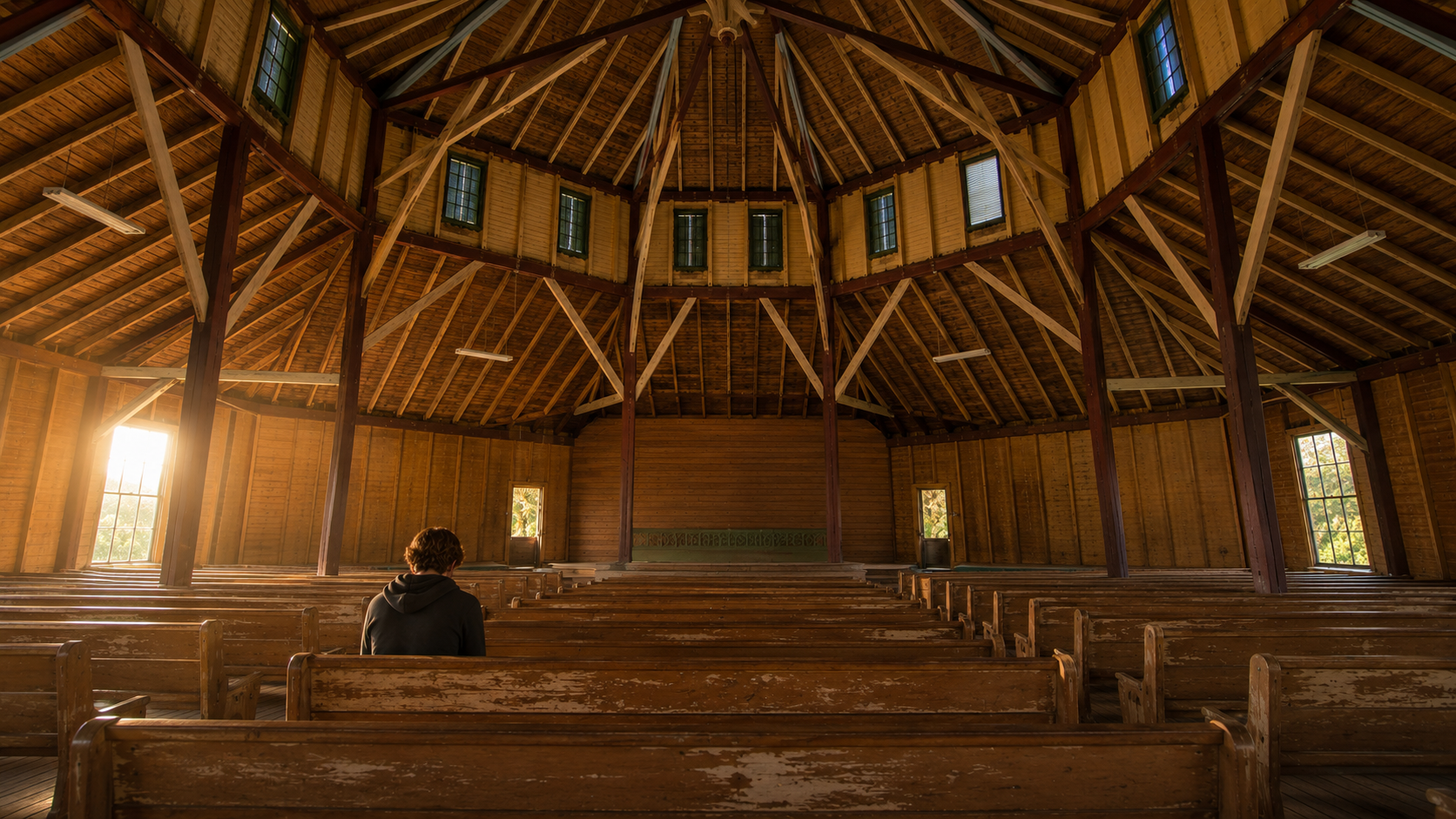
I began to wonder whether there was room in the church for someone like me.
The church I grew up in often reminded us that Christianity wasn’t just a religion full of rules.
It was all about having a close relationship with God. I believed that. I still do.
But that church also led me to feel as if that relationship came with an awful lot of conditions.
An awful lot of rules.
It often felt as though God’s love was unconditional…
provided I met the conditions…
provided I became someone else first.
I grew up in a church environment where being gay was not just discouraged—it was condemned.
As a child and teenager, I attended church services, youth groups, Bible studies, and Christian summer camps where the message was repeated over and over again: homosexuality was a sin.
Preachers spoke passionately about it from the pulpit. Guest speakers warned of moral decline. Youth leaders reinforced those messages. It was presented as a settled fact—something faithful Christians simply knew to be true. Being gay was wrong.
And with a father who was a minister in that church, aunts and uncles serving as Christian missionaries around the world, another uncle teaching at a Bible college, and grandparents deeply involved in church leadership, I was pretty sure I knew where my family stood on the issue.
When you hear the same message enough times, especially as a young person, it becomes part of the air you breathe.
The difficult part was that while these conversations were always about “those people,” I eventually realized they were talking about me.
For years, I prayed that I would change. I prayed that God would take those feelings away. I prayed that I could somehow become the person everyone expected me to be.
Today, I am comfortable being a gay man.
It took me years to believe and accept that my faith and my identity were never actually in conflict.
But before I came to believe that… there was fear.
Fear of disappointing my family. Fear of losing my community.
Fear of disappointing God. Fear of being rejected.
The author of First John writes:
“There is no fear in love, but perfect love casts out fear.”
I didn’t know how to believe that.
Eventually, I came out.
And my relationship with my church changed dramatically.
Many people were uncomfortable. A few were kind. Some were openly judgmental, Some claimed to be acting out of love while causing tremendous hurt.
I had one close high school friend, who is now a minister, who, when he found I was gay, compared my relationship with my boyfriend to his relationship with his dog.
I felt I had no choice but to leave the church. In doing so, I lost my entire community.
Church had been where many of my friendships were formed. It was where I spent weekends, summers, and important milestones of my youth.
There is a particular loneliness that comes from realizing you must choose between authenticity and acceptance.
For a time, I felt like I belonged nowhere.
But then, slowly, I started to connect with a church that led with genuine love instead of fear. I became connected with a church that made room for questions instead of demanding certainty. What I found there was very different from what I had experienced growing up.
Instead of being told that my identity made me unworthy, I was welcomed as I was.
Instead of hearing sermons about condemnation, I heard messages about genuine compassion, justice, and real, unconditional love. Instead of being treated as a problem to solve, I was treated as a person created in the image of God, not in need of fixing.
For the first time, I encountered a Christian community that did not require me to choose between my faith and who I am.
There was room for me.
Gay Daniel.
Broken Daniel.
Hopeful Daniel.
Just… Daniel.
There was room for me to worship. There was room for me to sing in the choir.
There was room for me to sit on the board and to chair the worship committee.
There was room for me to ask questions… difficult questions. There was room for me to grow.
There was room for me to be fully… myself.
Not because I had changed. Because I had finally found a church that truly understood the wideness of God’s welcome.
We sang earlier the hymn, Will You Come and Follow Me?
There is a verse that asks:
For a long time, I wasn’t sure I could. The church had taught me many things about God. But it had also taught me to fear a part of myself.
The hymn continues:
That line speaks deeply to my experience. Because my journey was not simply about being accepted by others. It was about learning to let go of fear. Fear that there was somehow no place for me in God’s story.
And then the hymn asks one more question:
“Will you use the faith you’ve found to reshape the world around?”
I think that is where this journey has led. Not merely toward acceptance. Not merely toward belonging. But toward helping others discover that there is room for them too.
Today, I stand before you not simply accepted, but invited.
As a teenager, I sat in church pews listening to sermons about people like me, but at the same time, I thought I would grow up to be a preacher like my father.
When I walked away from the church in my early 20s, I couldn’t imagine that one day I would stand in a church and be invited to offer a reflection during worship.
I don’t say that because there is anything extraordinary about me.
I say it because it illustrates what becomes possible when a church chooses belonging over exclusion, curiosity over judgment, and love over fear.
Making room… changes lives.
When people discover there is room for them… it creates belonging. In John 14:2, Jesus said,
When I was young, I understood that to mean there were rooms for those who were accepted because they’d followed the rules required to create a relationship with God.
I heard Christianity as a list of conditions. A list of requirements. A list of reasons someone might not belong.
But that’s not what Jesus was describing. He was describing a home.
The Greek word translated “rooms” refers to dwelling places or abiding places. It appears only twice in the New Testament—here and again in John 14:23, when Jesus says,
The emphasis is on God dwelling with people, not simply providing heavenly real estate.
He wasn’t describing a fortress with guards at the gate. He was describing a home. In the very next verses, he promises his frightened friends that there is room for them in his Father’s house, saying “I will come again and will take you to myself, so that where I am, there you may be also.”
Throughout Scripture, God’s desire is not simply to admit people into a building but to make them members of his household.
Homes are places where people belong. Homes are places where you stop pretending. Homes are places where people know your story, your struggles, your imperfections—and love you anyway.
God’s home is a place where people are welcomed with grace, and where Christ meets us in our brokenness.
Most churches, and in particular affirming communities of faith, describe themselves as “welcoming”. And I believe most churches are welcoming, to varying degrees.
Every church has people it finds easy to welcome. But every church also has people it quietly hopes won’t ask to join. The question is: who are those people in our churches?
Think of the person you instinctively find hardest to welcome. Notice who comes to mind.
I suspect that’s probably where Jesus would begin.
Now imagine someone you’ve never met walks into this church next Sunday, and before they’ve even spoken, your defences go up. Before they’ve introduced themselves, before you know anything about their story, you’ve already decided you probably won’t agree on much.
But the question isn’t whether you’ll agree. The question is whether they’ll know they’re loved before they leave.
Some of the people who come to mind may be someone recently released from prison for a crime we might consider unforgivable. Someone struggling with addiction, even someone who shows up at the doors of our church in the grips of their addiction. Someone whose politics make our blood pressure rise. Someone in a relationship we don’t quite understand or know what to do with.
Whoever they are… would they know there is room for them?
When I read the Gospels, I notice a pattern that repeats itself. Jesus rarely began with agreement. He began with building relationships.
Before people understood who he was, before their lives were put back together, before they had all the right answers… he noticed them.
He spoke with them. He shared meals with them. He invited himself over to their house. He loved them.
And somehow, in the safety of that love, lives began to change.
Again and again, Jesus created space for people whom respectable religious society preferred to keep at a distance. Tax collectors who were seen as corrupt and traitorous. Samaritans who were despised as religious and ethnic outsiders. Lepers who were isolated by illness and excluded from community. Women whose voices and status were often diminished in public and religious life. Foreigners who were treated as outsiders because they did not belong to Israel. Sinners whose reputations convinced many they were beyond God’s grace.
The religious establishment often focused on who was out.
Jesus seemed remarkably interested in who could be brought in. Jesus kept widening his circle.
The tragedy is that the Church has not always done the same.
When people are left wondering whether there is room for them, the consequences are not merely theological. They are deeply personal. They affect mental health, relationships, faith, and sometimes even the will to keep living.
It’s easy to think of these conversations as abstract theological debates. We discuss biblical interpretation. Church policy. Doctrine.
But for someone living the impact of them, these conversations are rarely abstract. They become deeply personal. They shape whether someone believes there is a place for them in the Church. Whether they believe they are loved by God. Whether they feel safe enough to tell the truth about who they are.
That’s why these conversations matter.
We rarely know the full story of another person’s life. The people sitting beside us may be carrying wounds we cannot see. The people we greet at the door may be carrying fears they have never felt safe enough to speak aloud.
Love is not found in the absence of difficult conversations.
Love abides when we create communities where people feel safe enough to have those conversations. Safe enough to ask questions. Safe enough to wrestle with doubt. Safe enough to tell the truth about who they are. Safe enough to discover, together, what it means to follow Jesus.
When I was growing up, people often talked about “those people.”
Every generation has its own version of “those people.” The question is whether we recognize who they are before we become the people excluding them.
The prophet Micah reminds us that God has already told us what faithfulness looks like:
“What does the Lord require of you but to do justice, and to love kindness, and to walk humbly with your God?”
Justice. Kindness. Humility. Those are lived every time we choose to make room for another human being.
Affirming communities of faith are about celebrating all people. But for many, affirmation is also about survival. Healing. And finding their way home.
For me, home was not found by leaving faith behind. It was found by discovering there was room for me within it.
When I was young, I wasn’t sure there was room for me. Today, I know there always was.
That is the work of the Church. Not to decide who deserves a room. But to help people discover the room God has already prepared.
Jesus tells us there are many rooms. Our calling isn’t to stand at the door deciding who gets a key. Our calling is to invite people home.
That’s what Jesus did. And that’s how Jesus welcomed me.





Leave a Reply